Showing posts with label self portraits. Show all posts

Sunday, February 13, 2011

Liberated in Ten Seconds


Imagine, if you would, that you are a photographic artist, but you have only ten seconds in which to take each shot, you use yourself as the model, and you never show your face. These are the three distinct signatures of my work. They mark each and every one of my images. And they challenge me in ways most photographers will not be able to imagine unless they have attempted this feat themselves.

Using myself as the model means that before each photo session I need to prepare myself to be photographed. It is not just a preparation of wardrobe, but of attitude as well. I have to feel confident that I will be able to express what I seek to in my art, through using myself as the model. This often challenges the kind of relationship I have with myself, and my with body. I don’t always feel like photographing myself, but that is inconsequential, as I engage my feelings in the image, no matter what they are. My photos, after all, are always reflections of something I am experiencing in my life. What better person to illustrate that then myself? So, I inevitably become my own model.

In using oneself as the model, you cannot see what you are creating until after you take the photo. You have nothing to look at except what lies in your imagination. You cannot direct the model to pose in accordance with what looks good to you through you camera’s lens. The composition is something you can only estimate. The exact aesthetics of the model’s form remain a mystery until after you have taken the shot, and return to your camera to see how it turned out. And you use no remotes, so you only have ten seconds once you set the timer on your camera to run back to the spot, and assume the desired stance, or pose. And don’t forget, your face must always remain a mystery.

These self imposed artistic disciplines usually force me to run back and forth between my camera, and the area my camera is aiming at, many times. I position myself in front of the camera, I wait for the signal, I listen, the shot is taken, I get up and return to my camera, then I look at the shot. Perhaps my face was tilted to face the camera? I need to reshoot. I set the ten second timer on my camera, run back to the spot, and do it again. Perhaps the lighting changed so my settings did not work? I do it again. Maybe I ran so fast back to the spot, I accidentally pulled the backdrop curtain down. Another reshoot. Sometimes, when I am aiming for a particular result, I may run back to my camera over 75 times. This is the number of shots it took me to come up with this image here:


With each photo shoot, I usually end up with close to 100 raw shots I upload to my computer for editing. That means I ran back and forth over 100 times. It is always interesting for me to see how many pictures I end up with, as I am often surprised by how many they are! For, when I am in the middle of a photo shoot, I am so energized by my own creativity, and the excitement of seeing the finished photos, that I rarely notice the passing of time, or the labor required involved in being one’s own model.

I believe that the most powerful art comes from a timeless, effortless dimension of sorts. Why don’t I set my camera to take several images at once? Why don’t I use a remote and give myself more time in which to settle into the pose? Because I like cultivating that timeless, effortless force in my art. As a result of this original, creative process, I’ve found myself developing a very tight relationship between time and space, and the way I fit into time and space. Instead of limiting my creative expression, I’ve found that my unique, artistic disciplines have challenged me to expand the ways in which I see myself, and my very existence. Thus, the ways in which I make art. Consequently ten seconds in which to find myself, and turn myself into art ends up being most liberating!

Tuesday, February 8, 2011

Art's Breath

Rudolf Steiner believed that a healthy lifestyle was one which mirrored healthy breathing, as one moved in and out of one’s activities in life, like the inward and outward breaths flow in and out of the body. Art, as I experience it, seems to have these two components to it as well. There appears to be an inward journey that connects the artist with what longs to be artistically expressed, and then there is the outward journey of expressing it.

Perhaps a work of art flows out in segments, as the artist inhales and exhales his or her way through the creative process. On the other side of the finished work is the audience. Continuing with Steiner’s poetic metaphor for life, perhaps the longest exhalation then, is represented by the sharing of one’s art. It’s when one’s art, or life breath, touches someone so intimately that it mingles with their breath. I think that, maybe, it is within such spontaneous creative fusion that lies the secret to making more art.

Recently, I had the opportunity to have my photographic art amazingly transformed into another medium: that of hand-painted images. It is wonderful to see another artist breathe new life into a work of your own! It always inspires me to connect with other artists and expand the perimeters of our own creativity. It is like expanding one’s breath to go deeper and fuller. When I collaborate with others, it makes me feel more alive! It is a special dynamic that perhaps connects us with that unlimited well of creativity that exists beyond us, and all around us. It is like that cosmic breath that is everywhere!

I invite you to breathe in our creations here. The first is a hand painted image by Gwen, a retired teacher, now art student, who uses soft pastels and is doing a study on figures. Here is her adoption of my self portrait titled “Silk”, followed by my original photograph taken on a ten second timer.


This next image is very special to me as it represents many things to me, and was created by the wonderfully talented artist and jazz singer Solitaire Miles. She produced this work of art by hand, through digital painting techniques, in only two days! She titled it “Belle Odalisque”, as we wished to capture some of the sensual beauty and exoticism surrounding medieval courtesans who were often used as models for the great masters. I see it as a symbol of feminine power, grace and freedom. Below is her gorgeous creation followed by my original self portrait, taken in ten seconds, my signature spontaneity. Please let me know how you like them! Hopefully they will take your breath away!


Tuesday, June 8, 2010

The Unfolding of an Image


In this blog I attempt to offer a little glimpse into the technical process involved in creating my photographs. It is a process that continues to develop gradually and organically, and primarily independently of any formal tutoring from anyone. The subject for this blog is inspired by Jearvi, a very talented female photographer with unlimited creativity and a wild imagination, and it dedicates itself to supporting the larger virtual community of photographers I have had the pleasure of meeting online, of which Jearvi is a part.


Perhaps I’ll begin by stating that I have never received any formal training in photography. I am self-taught, mainly through trial and error. I jumped into photography about two years ago, after my closest friend gave me a camera for my birthday. I had always wanted a good camera and was thrilled! I read through the manual and instantly put it to work, experimenting with the camera settings and familiarizing myself with it’s capacities. I reserved hours every week in which to give my undivided attention to my photography.


I seemed to be instantly moved to use my camera as an instrument for my voice. This naturally led to my creating self-portraits. The discovery of the ten second timer on my camera was enough to get me hooked! At first I lacked a tri-pod, so I used stools, counters, and chairs as stands for my camera. When shooting outdoors I usually carried a wooden stool with me, or balanced my camera on fences, or tree limbs! Finally I acquired a tri-pod.


I use a MacBook Pro computer, so when my photographs were uploaded from my camera they went directly into my computer’s photo software: i-photo. There I discovered I could adjust the colors on my images, and play with crops. About a year later, I became excited about what I was creating and wished to share it. I decided I would open a flickr account, though I was not very familiar with what exactly that was! The feedback I received from other flickr memebers proved to be most valuable, as I had unwittingly tapped into a whole network of professional and amateur photographers, eager to support one another. I began to feel as if I were a part of a photography-club of sorts, in which the members all offered one another encouragement, constructive criticism, lessons, challenges and, on rare occasions, even friendship.


Through my exposure to the other photographers on flickr I learned about photoshop and had it installed on my Mac. The potential of what could be created in this “digital darkroom” excited me tremendously! I taught myself to use other artists textures and then began experimenting with creating my own. Paintbrushes and textures opened up a whole new wold to me, as did the techniques required to create a composite image.


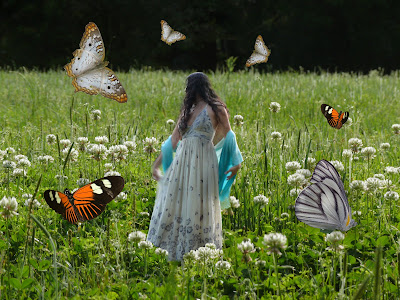
On Jearvi’s request, the following is a tutorial on how I create such images. I have chosen my latest image titled “In the Clover”. (There may be more effective, efficient means in which to do achieve this, but this is what I arrived at through my own uneducated efforts.)


First I began by taking this picture of clover growing on my front lawn. The sun was beginning to set behind them and I lay tummy down on the grass and used my zoom lens.


The next morning I took this picture of myself with my tri-pod and ten second timer. The sun was rising behind me.


In Adobe Photoshop CS3 Extended I opened the image of the clover as my first layer, or my “background image” and gave it a little color boost. Then I opened the image of my self, and using the “quick-selection” tool I drew an outline around my body. Then I refined the edge, and copied and pasted it onto the background image of the clover and adjusted it's size. I also had to cut and paste some extra clover flowers around and in front of the edge of my dress, to create the illusion that I was standing amidst the little flowers.


I then took three butterfly images and cut and pasted them into the picture in the same way, duplicating them as well, to make a total count of six butterflies. Lastly, I adjusted their size and moved them to the places I wanted them in.


Next, I gave my image an antiquated look by adjusting the color temperatures and tints, favoring yellow.


Finally, I selected my photoshop brush tool and set the tip to 300% size with an opacity of 38%, color black and played around with darkening the shadows and giving the edges somewhat of a vignette look. I did this until I felt I had achieved the look I wanted. The finished creation consisted of a total of ten layers:


I made this particular image on a day I was not feeling well and lay in bed a bit frustrated that I could not go outside. I had that passionate urge to create, so I plopped my computer on my lap and looked for photographs I had already shot the week before, hoping to somehow piece them together into some kind of art. The end result was the image you see above.


I am very new to this, so there may be easier ways in which to do this, but I share with you what I have taught myself thus far, in the hopes that it will inform your own creations in a helpful way. You can see the evolution of my art, if you wish by visiting my flickr photostream. Lastly, I thank Jearvi for suggesting this blog to me and I refer you all to her beautiful photostream for an endless flow of imaginative creations of this type, involving composite images, and lots of original and inspiring ideas! Click here: Jearvi and enjoy!


Sunday, May 30, 2010

Faceless Self-Portraits?

Most people’s idea of a self-portrait conjures up the image of a face. For the face is usually the most identifying visual characteristic of a person. When we experience a person’s physical presence we drink in their unique countenance; the eyes in particular. The eyes on a face are said to tell volumes about a person! They are often referred to as “the windows to the soul”, and are passages for intimacy. As an adolescent who expressed herself through paintings, I developed a habit of painting in the eyes in last. In doing so I felt as if I was finally infusing life and personality onto the canvass. A successful self portrait frequently gains it’s force from the presence captured in the eyes. So, how does one set out to effectively capture their own presence without ever showing their eyes?


In my personal communications with others I love face-to-face dialogue and lots of eye contact. It is therefore quite challenging for me to communicate through my self-portraits without ever facing the camera! I often end up deleting many of my photographs because in the urgency to express myself I look straight into my camera lens, and forget to look away before the ten second timer goes off. A fruitful photo shoot is usually one in which I’ve taken all communicative energy that naturally exists in my face and eyes, and moved it into my body. As most of our communication relies on kinesics anyway, I do not experience this as a sacrifice. Instead, I have found that in facilitating my desire to give my audience a powerful sense of my presence, without ever showing them my eyes, I inevitably stumble upon new means of visible expression. Expressing myself in this way, I offer others a visual experience of me.


What does it mean, then, to offer someone a visual experience of oneself? Must it include one’s face and eyes? Although a handful of observers have asked that I include my face in my self-portraits, most appear to gain a satisfying sense of my person through the appreciation of the other ingredients in my art. I contemplate this as I create my faceless self-portraits, and concoct recipes that will allow me to do so without entering too quickly into the classic image of a face. That is something I’d like to gradually work my way towards. Reserving my eyes for a grand-finale self portrait of sorts, seems to make the photographic journey leading up to it as enjoyable as a pre-climactic ascent of sorts. Not just for me, but, hopefully, for my audience as well.


I most delight in imagining that perhaps my photographs are like bridges connecting me to various audiences all over the world. Sometimes the connection can be very intimate, as when a person identifies with my work. I am told that the potential for this seems to increase as a result of my hiding my face and eyes. The vagueness of what I look like acts like an invitation for other women to see themselves, and their own emotions in my self-portraits. I find this merging of the artist with the observer very exciting and mysterious! How can one be certain they are regarding a particular person’s portrait unless it includes their face? Maybe my self-portraits are really portraits of something beyond myself, which includes everyone. Maybe in the undefined lines of my very exclusive, identifying characteristics, I open up my art to an inclusivity that embraces all women. I would like to think that I do: that in my faceless portraits I may actually be exhibiting the universal female face, at least to a tiny degree.


Saturday, May 29, 2010

Emotional Landscapes

From the time there were photographic portraits, there have been self portraits; that desire in humans to capture their own essence. And perhaps not only a desire to capture oneself, but an unmistakable desire to share one self as well!. In a sense, a self portrait is a desire, therefore, to be experienced by others.


When I create a self portrait I often ask myself this question: “Which part of me am I eager to have others experience today?” I’ve noticed that the parts of my being that feel the most unattended or unheard are often the ones that rise to the surface in my photographs. For example, if I am feeling sad one day, and unheard in my sadness, I may set out to create a rather melancholic, dark image of myself. I believe that in sharing that image, I invite others to validate the very sadness that drove me to create the image in the first place. In this context, I’ve found that it is almost an existential urge that drives me to create one self-portrait after another.


In exploring with sharing my self-portraits, I’ve uncovered a rather dynamic and even seductive dialogue that exists between the artist and her audience. I can’t think of anything more exciting, for example, than sharing feelings of mine through the creation of a photographic image, and having my images elicit equally strong emotional responses in others. Admittedly, I find something nearly addictive in this!


Especially satisfying to me is when I portray challenges or struggles I am feeling in my life through a self-portrait, and then, that portrait is amazingly appreciated by others. It is almost as if I am being told that my life’s struggles are worthy ones; and even beautiful ones at times!


This reminds me of Hippolyte Bayard’s famous self portrait entitled “Drowned Man”:


Taken in 1840, it is the first known self-portrait ever created, and interestingly narrates the tragic story of the utter desolation and discouragement he was experiencing at the time, as it depicts him dead. In it Bayard successfully paints an emotional landscape of himself rather than showing the external spaces and settings he lived in. Bayard manages to take what he was feeling on the inside and communicate it on the surface of his famous photograph. Although his self-portrait is one of feigned suicide, the public instantly found it beautiful! Perhaps in appreciation for the vulnerability an artist offers when they give themselves fully to a self-portrait.


I can certainly relate to Bayard’s need to express the inner world of feelings and emotions through images, no matter how disturbing those feelings may be. To me, being able to reveal what is normally invisible, through the creation of a photograph, can feel quite empowering! I aim to continue to reach deep inside myself and translate my feelings into images; hopefully adding to the history of self portraits that communicate the essence of our human experience, no matter how difficult it may be at times.